


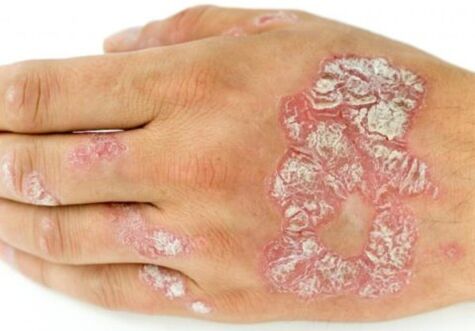
Psoriasis is a disease whose mechanism of occurrence is still not fully understood.However, it has been precisely established that some malfunction occurs in the immune system, due to which skin cells begin to divide at a very high rate without physiological downtime.This is how plaque psoriasis begins to form - an itchy patch covered with white scales (the same cells with a too short life cycle).
The exact diagnosis can only be made by a dermatologist after examination, but knowledge of the characteristics of the stages of the disease will help to draw the first conclusions about the nature of the skin changes that appear.
Psoriasis or not?
The disease goes through 3 stages:
- Progress.The onset of the disease can be sudden and may be preceded by severe stress or hormonal imbalance.A small red spot the size of a pinhead appears on the skin.Gradually, the surface of the changed skin area rises - this is a papule;Silver scales of keratinized skin can be seen on it.The papules combine to form patches, the skin is very itchy, and when scratched, it becomes wet due to damage to the surface layer.
- Stationery.After a certain time, the pathological process stops.No new spots and papules appear;Existing patches are covered with a gray, scaly crust that peels off easily.This stage is characterized by a decrease in the inflammatory process, itching gradually disappears, but the symptoms do not disappear completely.
- Regress.At this stage, the plaque clearly reduces and settles, and the skin becomes almost normal.Peeling and itching disappear.After the pathological factors are reabsorbed, pigments in the form of rings remain on the skin, which is due to the fact that the plaques in the central part disappear unevenly.After a few weeks, the last traces of spots and papules disappear, leaving only mild depigmentation resembling psoriasis.
The duration of the stages described may vary for each patient.The remission phase does not indicate recovery - the exacerbation may begin suddenly and unpredictably.
How to recognize psoriasis in the early stages?
Psoriasis treatments are most effective in the early stages, which explains the critical importance of an accurate diagnosis.Only a dermatologist can determine whether it is psoriasis or another disease after examination and testing.However, the patient himself can suspect this pathology if he pays enough attention to the newly appeared symptoms.
The following signs are more likely to indicate the development of this disease:
- The first plaques appear on the elbows, knees, hairline, or where the skin experiences the most friction or contact with clothing;
- rash accompanied by severe itching, silver scales easily peel off the skin surface;
- After removing the scab, the skin is slightly moist with blood spots (symptoms of spot bleeding);
- Later, small indentations often appear on the nails, as if created by a needle.
Psoriasis can be easily confused with various types of lichen, dermatitis and eczema, so at the first changes in the skin, it is better to consult a dermatologist so as not to harm yourself by using inappropriate products.The prescribed complex treatment will stop the uncontrolled proliferation of epidermal cells, reduce itching and peeling, restore the skin's barrier function and prevent infection.